
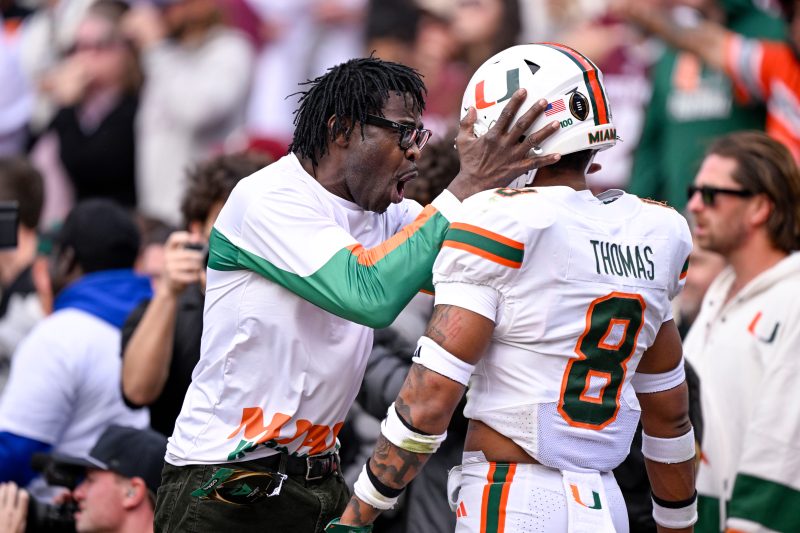
The Miami Hurricanes football program connects current players with program legends like Ray Lewis and Michael Irvin.
Coaches, many of whom are former players, use these legends to reinforce the team’s high standards and legacy.
While embracing the past, the current team is focused on creating its own unique legacy.
MIAMI — Before every game this season, Miami wide receivers coach Kevin Beard would gather his players together to FaceTime with former program greats such as Andre Johnson, Reggie Wayne and Santana Moss, asking each one: What do you expect to see from us?
A wideout for the Hurricanes himself in the early 2000s, Beard would open up the floor and let each former player share their thoughts on what it means to play receiver at Miami. In doing so, Beard’s current group would hear the same message he’d been delivering, but from outside voices with baked-in credibility.
“I want them to hear from somebody else,” said Beard. “So when they hear, they understand that this is the standard.”
Miami has long been defined in part by the parade of former players who continue to haunt the program’s halls and practice fields, passing along tips and tricks in a type of oral history.
“They understand it already,” said defensive line coach Jason Taylor. “They hear about it. The brotherhood the University of Miami has post-playing days is palpable.”
Led by a former Miami offensive lineman in coach Mario Cristobal and motivated by pregame speeches from program legends such as Michael Irvin and Ray Lewis, this year’s team has clearly taken these lessons to heart, leaving the Hurricanes one win away from the program’s national championship since 2001.
“You can’t afford to lose,” said offensive tackle Francis Mauigoa, who had the chance to spend time this season with former Miami linemen Bryan McKinnie and Jon Feliciano. “They were the tone-setters back then. So we want to continue on their legacy.
“You can see the sense of brotherhood that the program has. It’s something that you don’t get often.”
When talking to the team, as Lewis did before the Fiesta Bowl against Mississippi, these former players describe how the names, coaches and conference affiliations may change, but that every Miami player is responsible for continuing a legacy that dates back decades, even if the program has been mired in a generation-long championship drought.
“I’m learning anything I can,” he said. “It’s a little like, ‘Damn, that’s Ray Lewis. That’s Edgerrin James.’ At the same time, they’re here for us, and I’m taking as much knowledge that I can on and off the field.”
In some cases, understanding the legacy means going on YouTube and watching grainy, standard-definition clips of vintage TV broadcasts.
Irvin left Miami after the 1987 season and finished his NFL career in 1999, when Cristobal was in his second season as a Miami graduate assistant. Lewis retired in 2012 and James in 2009, when most of this year’s team was in elementary school.
But all three lingered around this installment of the Hurricanes, sharing what their teams looked like and their opinions on what creates and maintains a winning environment. Before the Peach Bowl, linebacker Wesley Bissainthe recalled, Lewis told the team to play for one another and to take things one play at a time.
“To have him come back and speak life into us, there’s no better feeling,” Bissainthe said. “We try our best to model our games after guys like that.”
This year’s team is the first since at least 2003 to find a place in Miami’s pantheon of great teams, joining championship-winning squads of 1983, 1987, 1989, 1991 and 2001 along with the many groups — in 1986, 1988, 1990, 2000, 2002 — that staked a claim to being seen as the best team in college football.
There’s a subtle turn-back-the-clock aspect to this year’s run to the championship game against unbeaten Indiana, in part because of Cristobal’s blueprint for reestablishing the Hurricanes’ physical dominance on the line of scrimmage. Because of his existing links to the program, Cristobal hasn’t shied away from connecting the past with the present; instead, the Hurricanes have embraced the expectations that come with tying the 2025 team with those that established Miami as a national power.
“That’s the foundation that we had,” Beard said. “We are living our lives trying to make the guys before us proud.”
But the Hurricanes also understand they are creating their own legacy.
“At the end of the day, they’re not the ones who are making plays,” said defensive lineman Ahkeem Mesidor. “This is the 2025 Miami team. It’s not 2001. It’s not the 1990s.”
Win or lose on Monday night, the 2025 team may go down as the one responsible for putting Miami back on the map, should the program’s upward trajectory continue deeper into Cristobal’s tenure.
This team is already responsible for erasing Miami’s reputation for folding under pressure by beating Notre Dame in the season opener, rallying from a midseason lull to make the playoff and then beating three higher-ranked opponents in Texas A&M, Ohio State and the Rebels.
A win against the Hoosiers might give Miami the most impressive postseason résumé of any team in Bowl Subdivision history, aided by the expanded playoff format. If so, the Hurricanes will have beaten the tournament’s No. 7, No. 2, No. 6 and No. 1 seeds.
While there are tangible ways to show how the Hurricanes have remained linked to the past, Miami has also forged ahead, said Cristobal, adapting to a new landscape of college football that’s miles removed from the era of the program’s heyday.
“To protect that and to keep the integrity of that, we’ve gone a route where it’s different than some of the traditional Miami teams, and that’s okay,” he said.
“But there was never any lean towards going back. You go back to take the principles and values and bring them forward. But to go forward, that’s in my opinion, as a head coach, the best way to do it.”
These Hurricanes are simply writing the next chapter, creating a unique legacy to layer upon the program’s existing history.
“We understand we’re right in the middle of the 2025 chapter of the Miami Hurricanes,” Taylor said. “We’re not living in the glory days or the former times.”